How to Calculate ROI for Text Messaging Campaigns (Simple Guide)


I just got back from the post office.
I bought a roll of stamps, and like most people lately, I had the same reaction.
“Wait… when did this get so expensive?”
The cost per stamp is now higher than most people expect. Once you factor in printing, design, and mailing time, your true cost per piece of mail is often over $1.00.
At the same time, I had just gotten off a call with a client.
They were running a text campaign and seeing a 23%+ click rate.
That contrast is hard to ignore.
With direct mail, you might hope someone opens the envelope. With texting, you know people are seeing the message, and a meaningful percentage are taking action within minutes.
That is why more organizations are starting to ask a better question:
“What is the actual return on this?”
We get asked this all the time:
“If I’m paying for text messages, how do I know if it’s actually working?”
The short answer is this. You need to understand your cost, your response, and your revenue. Once you see those three clearly, your ROI becomes easy to measure and easier to improve.
This guide will walk you through it in simple terms.
But First, a Quick Disclaimer
While fundraising is a primary use case, text messaging is not just about asking for money. In many cases, ROI is measured in engagement, participation, and relationship strength, not immediate dollars raised. Organizations use texting to send event reminders that increase attendance, share urgent updates during time-sensitive situations, deliver impact stories that build trust over time, recruit and coordinate volunteers, run surveys or polls to gather feedback, and follow up with donors to say thank you. These touchpoints may not generate revenue right away, but they improve retention, deepen relationships, and increase lifetime value over time.
For the sake of explaining ROI, we will focus on driving donations or revenue through text messages below.
What ROI Means (In Plain English)
ROI stands for Return on Investment. It tells you whether your campaign is making money or losing money.
If you spend $100 and generate $500, your ROI is strong. If you spend $100 and only bring in $80, something needs to change.
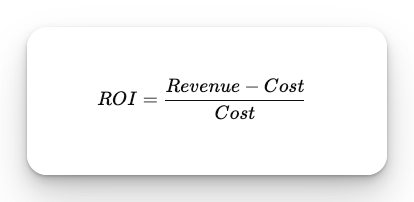
In text messaging campaigns, ROI helps you answer one key question:
“Are these messages producing more revenue than they cost?”
Understanding the Key Metrics
Before you calculate ROI, you need to understand a few core metrics.
Your click-through rate (CTR) is the percentage of people who click the link in your message. If you send 1,000 messages and 150 people click, your CTR is 15%.
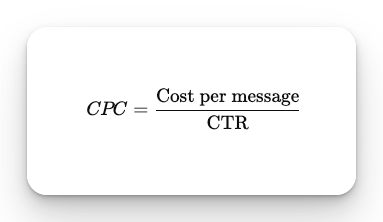
Your cost per click (CPC) tells you how much you paid to generate each of those clicks.
Your conversion rate (CVR) is the percentage of people who take action after clicking. This could be making a donation, signing up, or completing a form.
Your cost per acquisition (CPA) tells you how much it costs to get one donor. This is one of the most important numbers in your campaign.
Here are some examples:
| Conversion Rate | CPA |
|---|---|
| 5% | $13.40 |
| 10% | $6.70 |
| 20% | $3.35 |
A Simple Example
Let’s walk through a full example so you can see how everything connects.
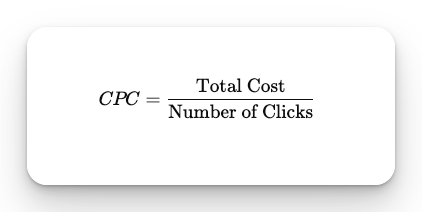
Imagine you send 1,000 messages at $0.10 each. Your total cost is $100. If your campaign generates a 15% click rate, that means 150 people click your link.
When you divide your total cost by the number of clicks, your cost per click comes out to about $0.67.
Now, assume your landing page converts at 10%. That means 15 of those 150 people take action and donate. When you divide your cost per click by your conversion rate, your cost per acquisition comes out to $6.70 per donor.
Why Text Messaging ROI Can Be So Strong
Text messaging performs well because it removes friction. People almost always have their phones nearby, so messages are seen quickly. It is also very easy to tap a link, especially when paired with an image or video, making it simple for someone to take action right away.
Unlike email, where messages may sit unread, text messaging creates faster action. That speed and visibility drive higher click rates and stronger ROI.
That said, performance is not automatic. It depends on how well your campaign is structured.
What Actually Drives Results
There are three main factors that determine whether your campaign succeeds or fails.
First is your audience. If your list is permission-based and relevant, your engagement will be higher. Sending to the wrong people will hurt your results, no matter how good your message is.
Second is your message. Clear and simple messages perform best. The strongest campaigns focus on one idea, one link, and one action.
Third is your landing page. This is where conversions happen. A slow or confusing page will reduce your ROI. A fast, mobile-friendly page with a clear ask will improve it.
When Does Texting Become Profitable?
A simple way to think about this is to compare your cost per acquisition to your average donation.
If it costs you $6.70 to acquire a donor and that donor gives $50, your campaign is highly profitable. If your acquisition cost starts to approach your average gift, your margins shrink.
So, for example:
If your average donation is $50, those 15 donors generate $750 in revenue.
You spent $100 to make $750, which gives you a 6.5x return.
The goal is not just to be profitable, but to build a system that can scale predictably.
Again, texting is not always about "asking for money". Sometimes it's just reaching out to say, "Hey, we see you."
Well worth the dime IMHO.
And much cheaper than a stamp.
Run Your Own ROI Numbers
Every organization is different, which is why it is important to model your own numbers.
You can use our ROI calculator to estimate your results:
https://www.rallycorp.com/roi-calculator
Plug in your click rate and average donation to see what your campaign could return.
Final Thought
Text messaging works best when it is treated as a strategy, not just a tool. When you combine the right audience, the right message, and a strong conversion experience, the math becomes predictable.
If you can consistently generate clicks at a reasonable cost and convert those clicks into meaningful actions, texting can become one of your highest-performing channels.
Want Help Building a 90-Day Plan?
If you want help applying this to your organization, we can walk through your numbers and build a clear plan.
We will help you:
- understand your current performance
- identify opportunities to improve
- map out a simple 90-day campaign
Book a consult and we’ll build it together.
About the Author

James Martin is founder of Rally Corp, helping nonprofits mobilize supporters with human-centered text messaging and mobile engagement. With 20+ years in marketing, he shares insights on the Your Rally Point Podcast and rallycorp.com.